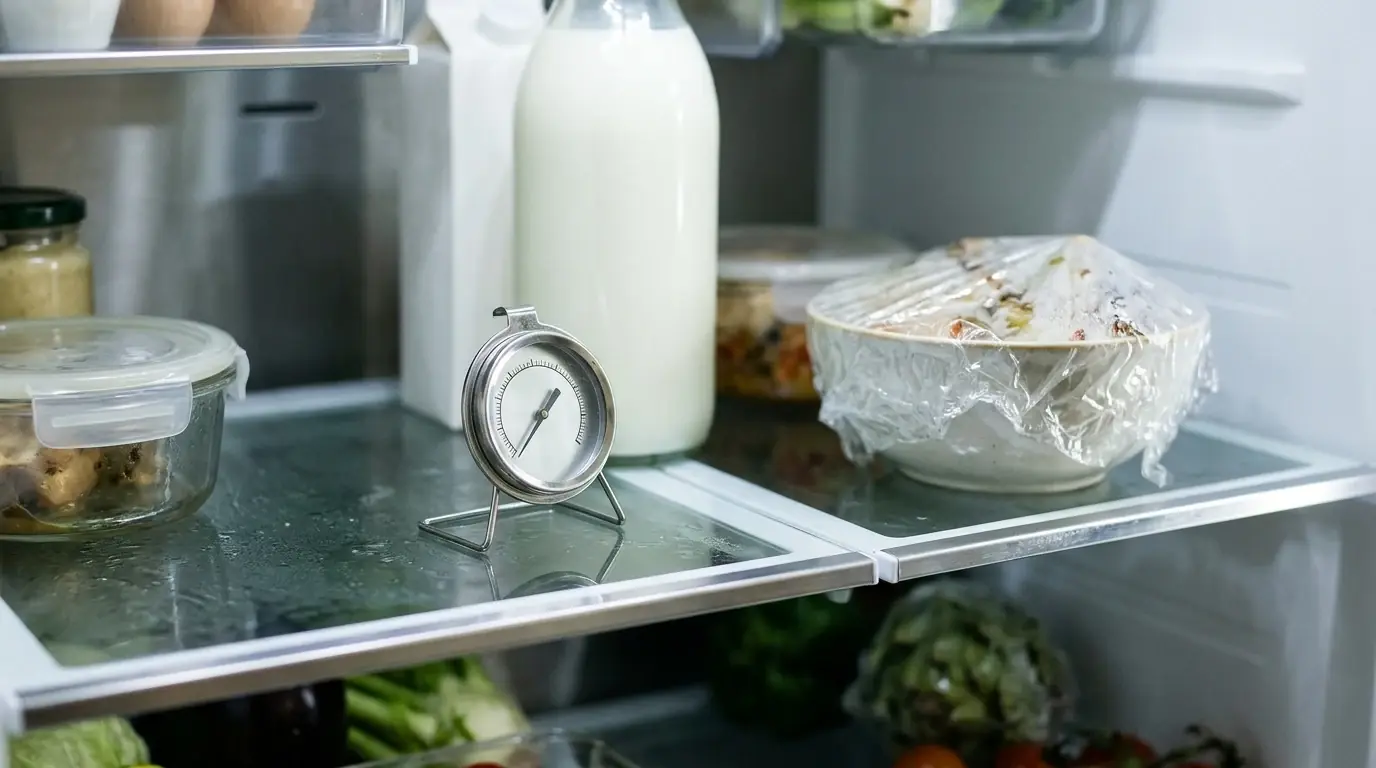
Your fridge should be at 40°F or below and your freezer at 0°F or below. If the fridge has been at 40°F or warmer for more than 2 hours, perishable food like milk, meat and leftovers should be thrown out. A closed fridge without power keeps food safe for up to about 4 hours; a full freezer about 48.
The numbers that matter
- Fridge: 40°F (4°C) or below.
- Freezer: 0°F (-18°C) or below.
- Bacteria that cause food poisoning multiply fastest between 40°F and 140°F.
- Power off, doors closed: fridge up to about 4 hours, full freezer about 48 hours, half-full freezer about 24 hours.
- Perishables above 40°F for more than 2 hours: throw them out.
These all come from USDA and FDA guidance published on FoodSafety.gov.
Rather have a technician look at it? See fridge repair here in Lufkin.
How to check the temperature
The dial or the number on the display is a setting, not a reading. Callers often tell us "it's been reading 52, even though I set the fridge to 32". Put an appliance thermometer, or any kitchen thermometer in a glass of water, on the middle shelf and read it after a few hours. Check the freezer the same way, with the thermometer between frozen packages.
What to keep, what to throw
- Throw out after more than 2 hours above 40°F: milk and cream, yogurt, soft cheese, raw or cooked meat, poultry and fish, leftovers, cooked rice and pasta, cut fruit.
- Frozen food that still has ice crystals, or is at 40°F or below, can be refrozen. It may lose some quality.
- Never taste food to find out if it's safe. When in doubt, throw it out.
Medicine in the fridge
If you keep insulin in the fridge, the FDA says unopened vials and cartridges can be kept unrefrigerated between 59°F and 86°F for up to 28 days and still work, away from direct heat and sunlight. Don't use insulin that has frozen. For any other medicine, check the label or ask your pharmacist.
Buying time
- Keep the doors shut. Every opening costs you cold air.
- Move the most important things (medicine, baby milk, meat) to a cooler with ice.
- Keep frozen food packed together. It stays cold longer.
When to call now
- The fridge is above 40°F and still rising
- The freezer is softening
- You keep medicine in it
See emergency refrigerator repair for what to do in the next hour.
Call (936) 304-3264What happens when you call
Tell us the brand and what it's doing. A technician comes out, finds the fault and gives you the price before any work starts, and you decide. More in how a repair visit works.
Sources
- FoodSafety.gov: food safety during a power outage
- FoodSafety.gov: cold food storage chart
- FDA: insulin storage in an emergency